Naming a streaming product
A practical shortlist exercise for choosing a name that people can say, spell, and place in the right category.
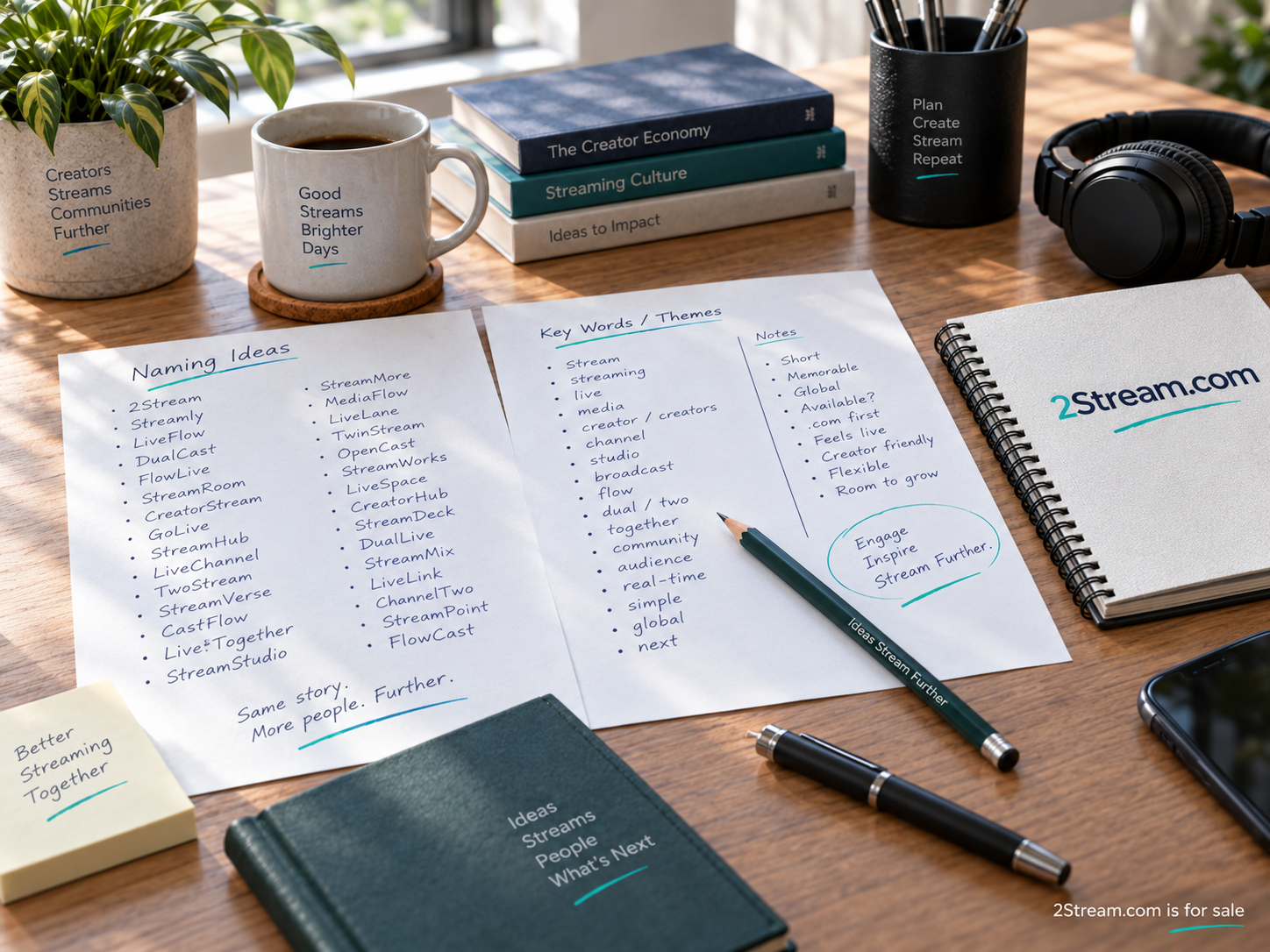
A naming meeting can produce plenty of opinions and very little evidence. One person wants a technical name, another wants something broad, and someone else wants a word that looks good beside a play icon. Before comparing candidates, decide what the first customer must understand. A name for broadcast software has a different job from a name for a sports channel.
This guide offers a working exercise for a team naming a streaming product. The outcome is a shortlist with recorded reasons, not a claim that a numerical score can predict success. Use it before commissioning a full identity or announcing the product publicly. The examples are illustrative and should be replaced with details from the actual business.
Write the product sentence first
Describe the customer, task, and result in one plain sentence. For example: “This tool helps a small production team prepare one live show for two destinations.” That sentence gives the naming discussion a reference point. If a candidate suggests an unrelated consumer entertainment service, the team can explain the mismatch instead of simply saying that the name feels wrong.
Keep the sentence independent of implementation. Customers may not need to know the protocol used to transport their video when they first encounter the brand. An implementation detail can belong in documentation while the main name describes a more durable product territory. The team should still be precise about what the software actually supports once customers begin evaluating it.
Ask the founder, a product lead, and a customer-facing colleague to write that sentence separately. Compare the answers before looking at names. If one describes an API and another describes a video community, the disagreement is about the product. Naming cannot resolve it by finding a word broad enough to conceal the difference.
Separate the brand from the feature label
A product name needs room to organize more than one feature, but it does not need to cover every possible future business. A useful test is to place the candidate above the first three likely navigation labels. Try it with “Events,” “Recordings,” and “Destinations,” or with the labels appropriate to the intended product. Read the combinations aloud.
Existing streaming businesses use different naming approaches. Mux’s documentation introduces a short brand alongside explicit video concepts. Restream’s introduction places its brand in the multistreaming category. These are examples of how names and descriptions can work together, not evidence that copying either pattern will produce the same business outcome.
A feature label can be more literal than the parent brand. “Recording review” tells a user where to go next. A brand does not have to carry every instruction itself. When a candidate requires a long explanation, however, examine whether the supporting description is doing reasonable work or rescuing a confusing choice.
Test spoken use without coaching
Give a participant the name in an ordinary sentence and ask them to write the address they would try. Do not explain the spelling first. Record the result, including any question about digits, plurals, or word boundaries. A candidate containing a number deserves a specific check for the digit versus the spelled-out word.
Then reverse the exercise. Show the written name briefly and ask the participant to say it. Use people who resemble the intended audience, including relevant language groups. A small informal test will not establish universal recognition, but it can uncover an obvious problem before the team becomes attached to a visual identity.
Keep the conditions consistent across candidates. Showing one name as a polished logo and another in plain text biases the comparison. Present all three in the same typeface and sentence. Avoid explaining your favorite candidate more warmly. The point is to notice what people understand without assistance.
Use a scorecard with visible reasons
Choose a short set of criteria before collecting opinions. Spoken clarity, spelling, category fit, room for the planned offer, and address consistency are reasonable starting points. Give each a simple scale, such as one to five, but require a short observation beside the number. “Two participants wrote the plural” is more useful than a bare score of three.
| Criterion | What to observe | What to record |
|---|---|---|
| Spoken clarity | Can a listener repeat the name? | The words or sounds they changed |
| Spelling | Can they write the intended address? | Digit, plural, and spacing questions |
| Category fit | What would they expect to find? | Their first product description |
| Product range | Does it fit the planned next feature? | Specific combinations that sound awkward |
| Address consistency | Does the name match the address being considered? | Extra words or punctuation to explain |
Do not average away a serious problem. A candidate might score well on appearance while repeatedly sending listeners to the wrong spelling. Mark issues that must be resolved before proceeding. Keep legal review separate from preference scoring; a popular candidate does not gain clearance because the team likes it.
Try the name in ordinary product copy
Write a welcome email subject, a support-page title, a spoken introduction, and a small mobile header. These are practical places where a name has to work. Include the full address in at least one example. A mark that looks elegant at poster size may become unclear when squeezed beside a navigation button.
For a streaming tool, also try an incident sentence and an account invitation. “Your event is ready in…” and “You have been invited to…” reveal different qualities from a marketing headline. The name should remain readable when the surrounding message is functional. Avoid judging only the most flattering presentation.
A team considering 2Stream.com, for example, could test how participants interpret the initial digit and whether the supporting product sentence clarifies the offer. That is a testable branding question. There is no need to invent a linguistic origin or claim that every listener will reach the same interpretation.
Make room for appropriate review
Before committing to a public launch, assign someone to coordinate trademark and other relevant checks with qualified advisers. Domain availability and brand clearance are separate questions. The naming exercise can help produce a shortlist, but it should not be presented as legal advice or a substitute for a proper review in the markets where the product will operate.
Also inspect the practical address plan. Decide which domain would be primary, where product documentation would live, and how an existing address would transition if necessary. Record ownership and renewal responsibilities internally. The team should not discover after printing event materials that nobody knows who controls the main account.
End the meeting with a decision record
A useful final note contains the product sentence, the three candidates tested, the observations, the chosen candidate, and any unresolved dependency. Name the person who makes the final decision. Set a date to resolve outstanding questions rather than reopening the entire discussion whenever a new suggestion appears.
The record does not need to be elaborate. Its value is preserving why a choice was made. If the product direction changes later, the team can revisit the relevant assumption instead of arguing from memory. A name selected for a creator utility may deserve another look if the company becomes a consumer sports network.
Start the exercise with three candidates and five ordinary uses, then listen to people outside the naming meeting. The best next step is usually a clearer observation: a misspelling, an unexpected category association, or a sentence that sounds natural. Those details give the team something concrete to improve before the name becomes expensive to change.